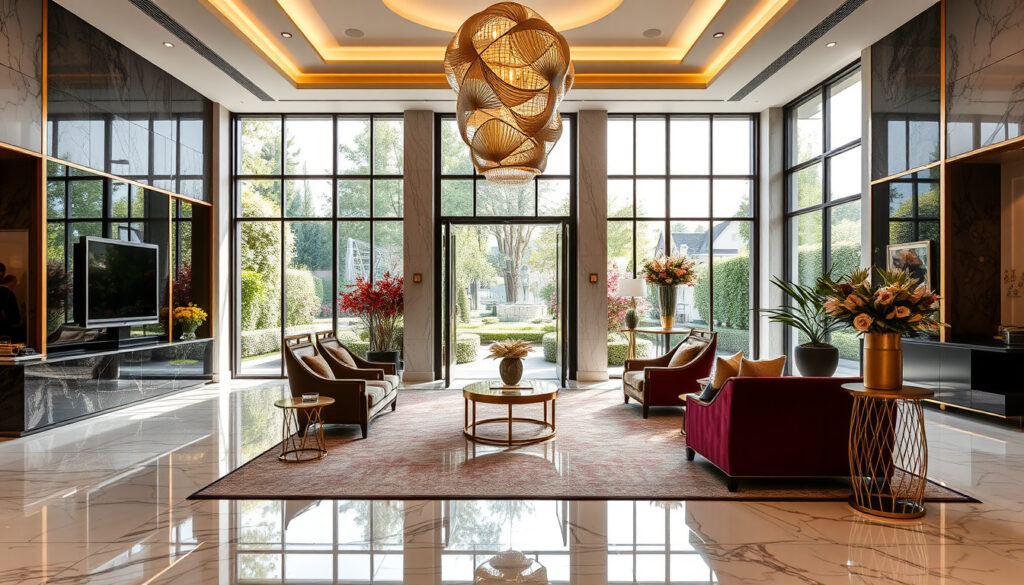
Luxury Interior Design: Elements, Materials, Rules & Trends 2026
You don’t need a designer’s budget to recognize luxury when you walk into a room — it’s about proportion, touch, and intention. Luxury interior design is less about price tags and more about the disciplined use of balance, material quality, and spatial harmony. This guide unravels what truly defines luxury interiors, from the three pillars of luxury to the 3-5-7 rule, and explores the trends shaping spaces in 2026.
Pillars of luxury design: 3 · Principles of interior design: 7 · Rule pattern for arrangement: 3-5-7 · Key material groupings: Natural stone, rich woods, metals, textiles · Current trend cycle: 2026–2027
Quick snapshot
- The seven core elements of interior design are space, line, form, texture, color, light, and pattern (Interior Design Institute USA (design education)).
- Natural materials such as marble, velvet, and polished wood consistently signal luxury (Elkafoury Group (interior design consultancy)).
- Exactly which trends will dominate beyond 2026 remains uncertain.
- The precise definition of “luxury” shifts across cultural contexts — no single formula exists.
- Whether sustainable luxury will become the default or remain a high-end niche.
- The exact role of smart home technology in luxury design is still debated.
- 2024–2025: Rise of quiet luxury and warm minimalism (Vallone Design).
- 2026: Biophilic materials and sculptural forms dominate (Vallone Design).
- 2027 forecast: Personalization and artisanal details gain prominence (Vallone Design).
- Expect sustainable luxury and biophilic design to move from trend to standard practice (Vallone Design).
- Smart home integration and texture layering will continue to define high-end spaces (Vallone Design).
Five facts, one pattern: luxury interior design rests on a small set of measurable principles that apply whether you’re decorating a penthouse or a reading nook.
| Attribute | Value |
|---|---|
| Pillars of luxury | 3 |
| Interior design rules | 7 |
| Classic rule pattern | 3-5-7 |
| Current trend year | 2026 |
| Primary material categories | Stone, wood, metal, textile |
What is luxury interior design?
- Luxury interior design is defined by quality, exclusivity, and attention to detail rather than by expense alone (Elkafoury Group (interior design consultancy)).
- It balances proportion, craftsmanship, and high-quality materials to create spaces that feel both elegant and inviting (Frankly Amsterdam (design blog)).
At its most distilled, luxury interior design is the intentional orchestration of space, light, texture, and object. It prioritizes harmony over clutter — minimal clutter and clean lines repeatedly appear in advice for achieving a luxurious feel (Frankly Amsterdam). The result is a room that feels composed, not decorated.
What are the three pillars of luxury?
- Identity: the brand or personal story behind the space.
- Access: scarcity or invitation that makes the experience exclusive.
- Experience: multisensory immersion through sight, touch, sound, and smell.
These three pillars — identity, access, and experience — reshape modern luxury across industries, including interior design. A truly luxurious room tells a story (identity), feels unrepeatable (access), and engages every sense (experience).
For a homeowner, the three pillars mean that luxury isn’t a checklist of expensive objects — it’s a narrative. If your room doesn’t tell your story or invite touch, it hasn’t crossed the line from expensive to luxurious.
The implication: luxury interior design is not about what you spend but how you balance these three forces. When identity, access, and experience align, even a modest room reads as luxurious.
What are the key elements of luxury interiors?
- High-quality materials, craftsmanship, balance, and cohesion are non-negotiable (Haus of Blaylock (design studio)).
- Luxury rooms often feature symmetrical layouts, statement pieces, and neutral palettes with texture depth (Interiors by Steven G. (residential designer)).
- Multi-layered lighting plans combining ambient, accent, and task lighting are standard (Elkafoury Group).
What makes a room look luxury?
- Symmetry and balance — matching sconces, centered furniture.
- Statement pieces — a sculptural chair, an oversized artwork.
- Neutral base with rich accent colors — beige walls with deep emerald or navy details.
- Layered textures — velvet cushions on linen sofas, silk drapes over wool rugs.
Custom or bespoke pieces also elevate a space by making it feel unique (Frankly Amsterdam). Natural elements such as plants, flowers, stone, and wood are frequently recommended to warm luxury interiors (Frankly Amsterdam).
How to incorporate luxury interior design on a budget
- Start with a neutral base — paint walls in warm off-white or soft gray. This creates a calm canvas.
- Add one statement piece — a vintage mirror, an artisan lamp, or a quality rug. One focal point shifts the whole room.
- Layer textures — mix velvet, linen, wool, and wood. Texture is the cheapest way to signal depth.
- Use the 3-5-7 rule for vignettes — group decorations in odd numbers (3, 5, or 7 items) for visual interest.
- Light in three layers — ambient ceiling light, accent wall lights, task reading lamps. Lighting changes the mood instantly.
Buying one well-crafted piece is smarter than filling a room with cheap replicas. A single solid wood coffee table outlasts five laminate ones and reads as luxury every time.
What materials are used in luxury interiors?
- Marble, hardwood, brass, velvet, silk, and handcrafted stone are top-tier choices (Elkafoury Group).
- Designers prioritize durability, rarity, and tactile appeal. Sustainable options like reclaimed wood and natural fibers are rising (Vallone Design (luxury design firm)).
Material richness in luxury interiors comes from natural stone, noble metals, and fine textiles. Marble counters, brass fixtures, velvet upholstery, and silk drapes create a tactile experience that synthetic materials cannot replicate (Interiors by Steven G.).
The catch: material rarity drives cost, but also longevity. A marble floor lasts decades; a laminate floor needs replacing in a few years. Sustainable luxury — recycled metals, reclaimed wood, natural fibers — is changing the sourcing landscape without sacrificing quality (Vallone Design).
What are the three pillars of luxury?
- Identity — the space reflects the owner’s personality, values, or brand.
- Access — the space feels exclusive, whether through rarity, invitation-only entry, or bespoke design.
- Experience — the space engages all senses: visual beauty, tactile comfort, acoustic peace, even scent.
These three pillars reshape modern luxury across industries, and interior design is no exception. A guest’s first impression of a room is shaped by identity (“whose home is this?”), access (“can anyone have this?”), and experience (“how does it feel?”). Designers who master all three create spaces that feel genuinely luxurious, not just expensive.
Why this matters: the three pillars give you a checklist to audit any room. If one pillar is missing — say, experience is weak because lighting is harsh — the room will feel incomplete regardless of cost.
What are the 7 rules of interior design?
- Balance — visual equilibrium through symmetrical or asymmetrical arrangement.
- Unity — a cohesive style and color scheme that ties the room together.
- Emphasis — a focal point that draws the eye.
- Contrast — difference in color, texture, or shape to create interest.
- Rhythm — repetition of elements to guide the eye around the room.
- Scale & proportion — furniture size in relation to the room and to each other.
- Details — finishing touches like trim, hardware, and accessories.
The 7 rules are widely accepted by the design community (Interior Design Institute USA). They apply whether you are staging a penthouse or arranging a single shelf.
What is the 3 5 7 rule in interior design?
- Group decorative objects in odd numbers: 3, 5, or 7 items per vignette.
- Odd groupings feel more natural and visually interesting than even-numbered pairs.
- This rule is a simple way to add rhythm and balance to shelves, coffee tables, and mantels.
The pattern: the 3-5-7 rule is a classic decorative guideline that creates visual tension without chaos. For example, a coffee table vignette of three stacked books, a small plant, and a sculptural bowl (five items total) feels intentional and luxurious.
What’s trending in interior design now?
- Trends for 2026 include biophilic materials, sculptural furniture, warm minimalism, and layered textures.
- Color trends lean toward earthy tones — terracotta, olive, ochre — with unexpected accent hues like deep plum or teal.
- Statement lighting — oversized chandeliers and artistic pendants — remains a key focal point (Vallone Design).
- Bathrooms are being treated as spa-like retreats with marble, gold fixtures, and freestanding bathtubs (Vallone Design).
The 2026–2027 cycle pushes personalization and artisanal details. Smart home integration continues to grow, but it’s expected to blend discreetly into the design rather than dominate (Vallone Design).
Biophilic design — living walls, indoor gardens, abundant natural light — is no longer a niche. Its rise signals a shift toward wellness-driven luxury that values air quality and connection to nature over pure opulence (Vallone Design).
The pattern: today’s luxury is quieter and more personal. The maximalist Art Deco revival still appears in bold geometric patterns and brass, but the dominant mood is warm minimalism — richness expressed through restraint.
Timeline: Luxury Interior Design Trends (2024–2027)
- 2024–2025 — Rise of quiet luxury and warm minimalism. Neutral palettes with rich textures and fewer, better pieces (Vallone Design).
- 2026 — Biophilic materials and sculptural forms dominate. Indoor gardens, organic shapes, and natural stone gain prominence (Vallone Design).
- 2027 forecast — Personalization and artisanal details take center stage. Handcrafted pieces become the ultimate status signal (Vallone Design).
This timeline signals a clear direction: luxury interiors are moving away from flashy opulence toward substance, sustainability, and the personal fingerprint of the owner.
Clarity: What We Know and What’s Unclear
Confirmed facts
- The 7 principles of interior design are widely accepted by design educators and practitioners.
- The 3-5-7 rule is a common decorative guideline used by professional designers.
- Natural materials (stone, wood, wool, linen) are consistently associated with luxury across markets.
- Multi-layered lighting plans are a hallmark of professional luxury design.
What’s unclear
- Exactly which trends will dominate beyond 2026 — some sources predict maximalism, others quiet luxury.
- The precise definition of “luxury” varies by cultural context and individual taste. A luxury interior in Milan may look different from one in Tokyo.
- Whether sustainable luxury will become the default or remain a high-end niche.
- The exact role of smart home technology in luxury design is still debated.
The implication: while many principles are well-established, the future of luxury interior design will depend on how designers balance these uncertainties with timeless rules.
Expert Perspectives on Luxury Interior Design
“Luxury interior design is not about excess. It’s about the careful balance of proportion, material quality, and craftsmanship to create a space that feels both elegant and inviting.” For a deeper dive into the evolving landscape of digital transformation in Italy, consult the Guida al Piano d’Azione Digitale Italia 2026.
— Elkafoury Group (interior design consultancy) Elkafoury Group
“The 3-5-7 rule is one of the simplest ways to achieve visual interest. When you group objects in odd numbers, the eye moves more naturally, and the arrangement feels less forced.”
— Frankly Amsterdam (design blog) Frankly Amsterdam
“Layering textures — velvet, linen, wool, wood — is what gives a room depth. Without texture, even the most expensive furniture can feel flat.”
— Haus of Blaylock (design studio) Haus of Blaylock
These perspectives converge on one insight: the best luxury interiors are felt, not priced.
For the homeowner reading this guide, the choice is clear: invest in proportion, texture, and quality over quantity. Whether your budget allows a single artisan piece or a full renovation, applying the principles of balance, the three pillars of luxury, and the 3-5-7 rule will make any space read as more luxurious. The alternative — chasing trends without structure — will leave you with a room that looks expensive but feels empty.
Related reading: **luxury interior design guide** · **luxury interior design elements and materials**
For a deeper dive into these principles, the LuxuryInteriorsOrg blog offers a wealth of design ideas and trend analyses.
Frequently asked questions
How much does luxury interior design cost?
Costs vary widely depending on location, scope, and designer prestige. Many designers charge by the hour or as a percentage of the project budget. A full luxury redesign can range from $15,000 for a single room to $150,000+ for an entire home.
Can I achieve luxury style on a budget?
Yes. Focus on the principles: balance, the 3-5-7 rule, layered lighting, and quality over quantity. One well-made sofa and a few carefully chosen accessories can transform a room without a high-end budget.
What are the most popular luxury design styles?
Current leading styles include warm minimalism, biophilic design, maximalist Art Deco revival, and quiet luxury. Each emphasizes material richness, but their visual language differs.
How do I choose a luxury interior designer?
Look for a portfolio that aligns with your taste, check client testimonials, and ask about their process. Credentials from organizations like the Interior Design Institute can be a signal of formal training.
What colors are considered luxurious?
Neutrals like cream, beige, taupe, and soft gray form the base. Accent colors such as deep emerald, navy, burgundy, and ochre add depth. Rich, earthy tones are currently on trend.
How often should I update luxury decor?
Luxury interiors are designed to last. Update soft furnishings every 5–7 years, rotate seasonal accents annually, and consider larger renovations every 10–15 years. A timeless design reduces the need for frequent updates.
What is the difference between luxury and high-end design?
High-end design focuses on expensive materials and brand names. Luxury design goes deeper — it prioritizes proportion, craftsmanship, comfort, and a sense of exclusivity. A room can be luxurious without being expensive if the principles are right.
Related reading: For a deeper look at the principles covered here, explore our luxury interior design guide.
More related posts
 Cassie Sharpe: Olympic Gold, Motherhood, and Recent Setback
 Corey Feldman: Why Depp Fired Him, Divorce, and Life Today
 Steve Nash: Career, Stats, Personal Life & Current Role
 Jodie Sweetin: Life, Addiction & Cast Relationships
 Sara Saffari: Age, Height, Controversy, Relationship with Trevor Wallace
 Matt Czuchry: Relationship Status, Kids, and Career
 House of Guinness Cast: Full List of Actors & Characters 2025
 Sydney Sweeney’s Sheer Silver Dress Steals the Show