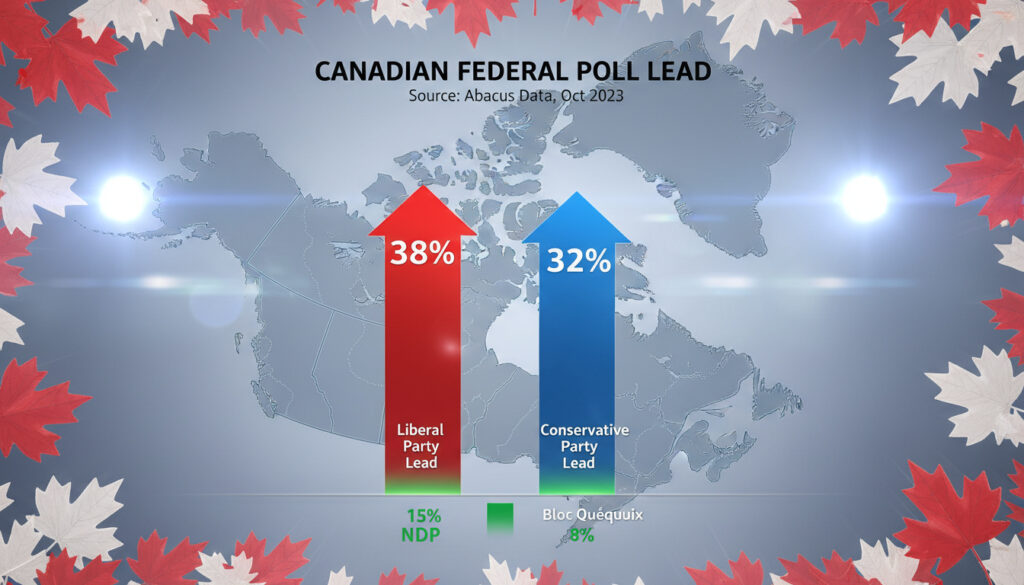
Poll Tracker Canada Today – Latest Federal Polls and Leads
Liberals under Mark Carney hold a commanding position in federal polling as of late March 2026, consolidating support in the mid-40 percent range while Conservative numbers hover in the low 30s. Aggregators tracking daily movements show the governing party maintaining a double-digit advantage nationally, a dramatic reversal from Conservative leads recorded through much of 2024.
Recent data from National NewsWatch and 338Canada place Liberal support between 44 and 46 percent among decided voters, compared to 30 to 33 percent for Conservatives led by Pierre Poilievre and roughly 9 percent for the NDP. The New Democratic Party has shown modest recovery to approximately 10 percent support in some surveys, though leadership transitions continue to generate internal uncertainty.
The current landscape reflects stabilization following volatile shifts during and after the 2025 federal election campaign. Economic concerns remain the primary driver of voter alignment, with recent tracking indicating Liberals hold a 13-point advantage on economic management.
Who Is Leading the Federal Polls in Canada Today?
44-46%
30-33%
~9%
+12 to +20 pts
- Liaison Strategies tracking shows consistent 12-to-15-point Liberal advantages in weekly updates throughout March 2026.
- Ekos research reveals a potential 20-point gap, with Liberals at 47.5 percent and Conservatives at 27 percent.
- Mark Carney maintains a 32-point edge over Pierre Poilievre as preferred Prime Minister.
- Economic issue tracking favors Liberals 45.7 percent to 32.9 percent over Conservatives.
- The NDP has recovered to approximately 10 percent support but faces ongoing leadership questions under figures such as Avi Lewis.
- Regional variations show tightening contests in Ontario while Quebec, Atlantic Canada, and British Columbia display wider Liberal leads.
- Methodological consistency across aggregators suggests the national lead is structurally sound rather than an outlier.
| Party | Support | Lead/Change | Pollster | Date | Sample |
|---|---|---|---|---|---|
| Liberals | 45% | +12 | Liaison | Mar 2026 | 1,000 |
| Conservatives | 33% | – | Liaison | Mar 2026 | 1,000 |
| NDP | 9% | – | Liaison | Mar 2026 | 1,000 |
| Bloc | 6% | – | Liaison | Mar 2026 | 1,000 |
| Liberals | 47.5% | +20.5 | Ekos | Mar 2026 | – |
| Conservatives | 27% | – | Ekos | Mar 2026 | – |
| Liberals | 41% | +2 | Abacus | Apr 2025 | 2,500 |
| Conservatives | 39% | – | Abacus | Apr 2025 | 2,500 |
How Do Poll Aggregators Model Canadian Federal Support?
Methodology Behind the Numbers
338Canada, created by Philippe J. Fournier, employs multilevel regression with post-stratification (MRP) to weight recent polls against electoral history and demographic data. The model integrates multiple data sources rather than relying on single snapshots, producing rolling averages that account for sample variability.
Individual pollsters utilize random national sampling with likely-voter screens. Abacus Data applies filters based on advance voter history and self-reported certainty to turn out, a methodology that accurately predicted previous electoral outcomes.
Understanding House Effects and Weighting
Aggregators apply house effect corrections to neutralize persistent biases between polling firms. Recency weighting ensures older surveys contribute less to current projections than fresh fieldwork. Demographic adjustments align sample compositions with actual voter distributions by age, region, and education.
Margins of error for recent federal polls typically range between 2.5 and 3.1 percent with 19/20 confidence levels, based on sample sizes of 1,000 to 2,500 respondents. These intervals mean reported leads of 12 to 20 points remain statistically significant, though individual data points may vary within the stated ranges.
What Do Regional Polls Reveal About Provincial Battlegrounds?
Ontario’s Tightening Race
Abacus Data from April 2025 showed Liberals leading 45 percent to 42 percent in Ontario, indicating a substantially narrower margin than the national spread. Recent provincial tracking suggests continued competitiveness, with the Greater Toronto Area serving as the primary battleground for seat optimization.
Liberal Dominance in Quebec and Atlantic Canada
Atlantic Canada and Quebec display substantial Liberal advantages according to national trackers. These regions contribute significantly to aggregate seat projections, offsetting narrower margins elsewhere. British Columbia similarly shows wide Liberal leads in current measurements.
Prairie Resistance and Shifting Sands
Alberta and Saskatchewan present tighter competition, though Carney’s outreach efforts have narrowed historical gaps. One March 2026 tracker placed Liberals at 46 percent nationally while showing measurable gains in Prairie provinces compared to historical baselines.
Vote efficiency varies significantly by region. Liberals can secure majority governments with narrower national leads if their support concentrates in Ontario, Quebec, and Atlantic Canada, while Conservative votes often stack inefficiently in Prairie strongholds.
What Seat Projections Emerge from Current Trends?
338Canada projections favor a Liberal majority government if an election occurred today, utilizing MRP-style demographic modeling rather than direct vote intention translation. The seat calculator accounts for regional efficiencies, incumbency effects, and riding-level demographic patterns.
Abacus Data’s final 2025 campaign survey predicted a narrow Liberal victory with 41 percent to 39 percent popular support, potentially yielding 170 or more seats through efficient distribution across Ontario, Quebec, Atlantic Canada, and British Columbia. Older CBC analysis via Éric Grenier contrasted these levels favorably against 2021 Conservative seat counts, suggesting majority territory.
Seat projections represent probabilistic models assuming current conditions persist until an election. Ranges account for significant uncertainty, with mean outcomes proving more likely than extreme scenarios. No specific election date has been confirmed following the 2025 vote.
How Have Federal Polls Shifted Since the 2025 Election?
- : Abacus Data final campaign poll shows Liberals at 41 percent among likely voters, Conservatives at 39 percent, indicating a dead heat heading into election day.
- : Conservative leads flip dramatically as Liberal fortunes reverse, beginning a sustained upward trajectory that continues into 2026.
- : Liberal support peaks during the campaign period before slight tightening as voters consolidate choices.
- : Liaison Strategies tracking establishes consistent 12-to-15-point Liberal advantages in weekly national surveys.
- : Ekos reports exceptional 20-point gap with Liberals at 47.5 percent, Conservatives at 27 percent, and NDP at 15.1 percent.
- : 338Canada updates projections showing stabilized Liberal dominance with weighted averages consolidating around 44-46 percent.
Which Polling Trends Are Definitive and Which Remain Uncertain?
Established Information
- Liberals hold national leads of 12 to 20 points across multiple reputable pollsters
- Mark Carney maintains substantial preferred Prime Minister advantages
- Economic concerns represent the primary driver of current party support
- Margins of error range from 2.5 to 3.1 percent for standard sample sizes
- MRP methodology accounts for demographic and regional variations
Remaining Uncertainties
- Specific timing of the next federal election remains unconfirmed
- Full breakdown of house effects between individual polling firms
- Long-term impact of NDP leadership transitions under potential candidates such as Avi Lewis
- Turnout model accuracy beyond the 2025 election cycle
- Extent of Liberal gains in Prairie provinces over time
Why Are Economic Concerns Driving Current Polling Trends?
Economic management has emerged as the decisive wedge issue separating the major parties. Current tracking indicates 45.7 percent of voters trust Liberal stewardship on economic files compared to 32.9 percent for Conservatives, a reversal of historical patterns where conservatives typically dominated fiscal credibility metrics. To understand these shifts, explore Canada’s federal polls. Canada’s federal polls
This shift coincides with Mark Carney’s entry into federal politics, leveraging his central banking background during periods of tariff uncertainty and trade instability. Voters facing Costco Gas Price Today – Current Rates, Savings and Tips and broader cost-of-living pressures appear to favor technocratic experience over opposition critiques.
The phenomenon extends beyond pocketbook issues into trade policy, where Liberal messaging on U.S. relations appears to have consolidated support in manufacturing-dependent regions of Ontario and Quebec.
Which Sources Provide Reliable Federal Polling Data?
338Canada operates as the principal federal aggregator, maintaining quick links to regional breakdowns for Ontario, Quebec, and other provinces. The platform applies recency weighting and house effect corrections to produce rolling averages updated through March 29, 2026.
National NewsWatch aggregates releases from multiple firms including Liaison Strategies, Ekos, and Leger, providing weekly federal updates and tracking Carney approval ratings alongside standard vote intention metrics.
Historical context for 2025 polling is available through Wikipedia’s comprehensive election archive, while Elections Canada maintains official documentation regarding the 2025 advance polling period held April 18-21.
What Is the Current State of Canadian Federal Polling?
Federal polling as of late March 2026 positions Liberals under Mark Carney firmly in control with 44 to 46 percent support against Conservative levels of 30 to 33 percent and NDP figures near 9 percent. Aggregators project majority government potential based on efficient vote distribution across Ontario, Quebec, and Atlantic Canada, though margins in the Prairies and British Columbia continue to evolve. For readers tracking unrelated infrastructure vulnerabilities, see Solar Flares Cause Blackouts – Myths and Facts.
Frequently Asked Questions
What is MRP modeling in Canadian polling?
Multilevel Regression with Post-stratification (MRP) is a statistical technique used by aggregators like 338Canada to weight raw poll data against demographic and electoral history, producing more accurate seat projections than simple vote share averages.
How do house effects impact reported results?
House effects refer to persistent methodological biases between polling firms. Aggregators correct for these variations by adjusting raw numbers to neutralize consistent over or under-estimation patterns specific to each pollster.
What sample sizes do current federal polls use?
Recent surveys utilize between 1,000 and 2,500 respondents randomly selected from national panels, yielding margins of error between 2.5 and 3.1 percent at 19/20 confidence intervals.
Which pollster currently shows the widest Liberal lead?
Ekos research published in late March 2026 displays a 20.5-point advantage for Liberals at 47.5 percent versus 27 percent for Conservatives, exceeding the 12-to-15-point leads shown by Liaison Strategies tracking.
How accurate were 2025 election polls?
Abacus Data’s final 2025 survey accurately predicted a narrow Liberal victory using likely-voter filters based on advance voting history and turnout certainty, validating the methodological approach for future projections.
When is the next federal election scheduled?
No specific election date has been confirmed following the 2025 federal vote. Projections assume a hypothetical “if held today” scenario rather than predicting specific timing.
More related posts
 2 Weeks Notice Letter: Template, Sample & How to Write
 Travelodge by Wyndham Edmonton West – Review, Amenities and Guest Feedback
 House of Guinness Cast: Full List of Actors & Characters 2025
 Pulled Pork Instant Pot – Tender in Under 2 Hours
 Sydney Sweeney’s Sheer Silver Dress Steals the Show
 Riley Keough Movies and TV Shows – Complete Filmography Guide
 Teacher Strike Alberta Update Today – Over After Bill 2 Passage
 Cavalier King Charles Spaniel – Complete Breed Guide