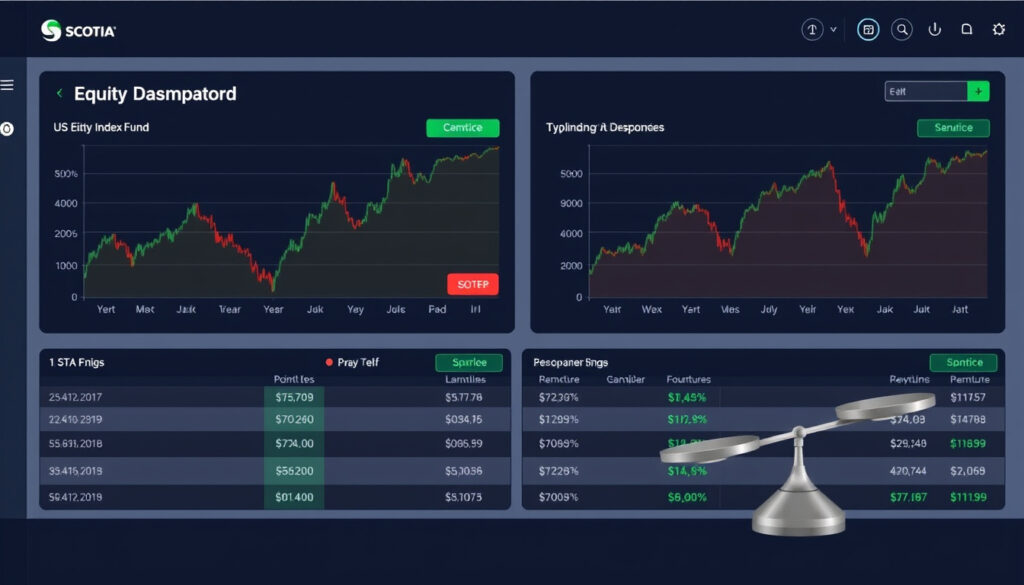
Scotia US Equity Index Fund – Performance Fees and ETF Comparison
The Scotia US Equity Index Fund is a mutual fund managed by Scotiabank that gives Canadian investors exposure to the broader United States equity market by tracking a leading American stock market index. Designed for investors seeking long-term growth through diversified holdings across major U.S. companies, the fund operates as one of several Scotia index offerings targeting different markets and asset classes.
As with any investment linked to foreign markets, holders of this fund bear currency conversion risk, since returns are calculated in Canadian dollars even as the underlying holdings trade in U.S. markets. The fund competes in a crowded category of Canadian-index products, including a lower-cost ETF alternative issued by the same institution. Understanding the fee structure, historical performance, and how the fund stacks up against comparable products is essential for making an informed allocation decision.
This article draws on data from Fund Library, Scotiabank’s official fund documentation, and the Scotia U.S. Equity Index Tracker ETF factsheet to provide a factual overview of the fund’s structure, performance history, and practical considerations for Canadian investors.
What is the Scotia US Equity Index Fund?
The Scotia US Equity Index Fund is a passively managed mutual fund that seeks to replicate the performance of a broad U.S. equity index, most commonly identified as the S&P 500. The fund’s Series A offering is available through Scotiabank’s mutual fund platform, allowing investors to purchase units via advisors or directly through Scotiabank’s online account management tools. As a mutual fund, it carries end-of-day pricing, meaning the net asset value is calculated once daily after markets close.
The fund holds a diversified basket of U.S. equities spanning multiple sectors, with a concentration reflective of the underlying index’s composition. Information technology and financial services have historically represented significant portions of the portfolio given the index’s structure. Holdings details for the mutual fund specifically are not separately disclosed in available public filings, though the fund’s investment objective mirrors that of broad U.S. equity indices tracked by comparable products.
Fund Snapshot
The Scotia US Equity Index Fund offers Canadian investors a way to gain exposure to the U.S. equity market through a single mutual fund investment, with the convenience of purchasing through Scotiabank’s established platform. It is one of several index-oriented products within the Scotiabank mutual fund lineup.
- Structure: Mutual fund with end-of-day NAV pricing
- Index Tracked: Broad U.S. equity index (typically S&P 500)
- Series: Series A (standard retail offering)
- Currency: Canadian dollar-denominated with U.S. equity exposure
- Management Approach: Passive index replication
How It Compares to Other Scotia Index Funds
Scotiabank offers a range of index funds covering Canadian, international, and emerging market equities, each structured similarly but targeting different geographic benchmarks. The Scotia US Equity Index Fund specifically focuses on large-cap U.S. companies, differentiating it from funds that cover broader global markets or smaller market segments. Investors interested in comparing geographic exposure can review the full lineup of Scotia U.S. equity funds on the official platform.
| Metric | Value | Context |
|---|---|---|
| Primary Benchmark | S&P 500 | Broad U.S. equity market index |
| 2024 Annual Return | 34.54% | Outperformed category average (26.98%) |
| 2025 Annual Return | 11.28% | Above category average (8.65%) |
| 10-Year Annualized Return | 13.90% | Trailed benchmark (15.59%) |
| Category Rank (2025) | 373 of 1,288 | Top quartile performance |
| Management Approach | Passive | Index replication strategy |
How Has the Scotia US Equity Index Fund Performed?
Performance data for the Scotia US Equity Index Fund reflects its passive management strategy: the fund closely tracks its benchmark index, delivering returns that generally fall near the category average but slightly below the benchmark itself. This pattern is consistent with how passively managed index funds operate, where tracking error and management fees create modest divergence from the underlying index.
Annual and Multi-Year Returns
According to data reported through early 2026, the fund delivered its strongest calendar-year return in the past decade during 2024, posting a gain of 34.54%. That result outpaced the category average of 26.98% among Canadian-listed U.S. equity funds but fell short of the benchmark’s 36.01% return for the same period. The fund ranked 391st out of 1,244 funds in its category that year, placing it in the top third.
The following year brought more modest but still positive results. In 2025, the fund returned 11.28%, again exceeding the category average of 8.65% while trailing the benchmark return of 12.28%. Its ranking improved to 373rd out of 1,288 funds, positioning it in the top quartile. Longer-term performance remains competitive: the 5-year annualized return stands at 14.05% and the 10-year annualized return at 13.90%.
Over the 10-year period, the fund has generated solid returns but has consistently lagged its benchmark. The 10-year benchmark return of 15.59% versus the fund’s 13.90% reflects the compounding effect of management fees and tracking variance over time. Investors can review detailed performance figures on the Fund Library listing for the Scotia US Equity Index Fund.
Recent Short-Term Performance
Short-term performance data reveals month-to-month volatility consistent with equity market fluctuations. As of the latest available figures, recent returns include a 1-month return of -0.72%, a 3-month return of -2.26%, and a year-to-date return of -0.39%. The 1-year return of 8.84% demonstrates positive performance over the most recent twelve-month window, while shorter-term periods reflect typical market corrections.
Monthly return comparisons between fund variants and the S&P 500 show close alignment, confirming the fund’s intended role as a pure index tracker. For example, the Series F variant averaged -5.30% during one measured month period compared to the S&P 500’s -4.78%, a difference attributable to fees rather than strategic positioning.
The Scotia US Equity Index Fund tracks a broad U.S. equity index, and the benchmark referenced in performance reporting is frequently the S&P 500. It is worth noting that the fund’s reported benchmark return of 36.01% in 2024 exceeded what most investors would associate with the S&P 500 for that year, suggesting the specific tracked index may differ slightly or that dividend reinvestment assumptions affect calculations.
What Are the Fees and Costs of the Scotia US Equity Index Fund?
Fees represent one of the most significant distinctions between the Scotia US Equity Index Fund and its lower-cost ETF counterpart. As a Series A mutual fund, the fund carries a management expense ratio that, while not publicly disclosed at a precise figure in available data sources, falls within the typical range for actively or passively managed Canadian mutual funds in this category.
Management Expense Ratio
The Management Expense Ratio for the Scotia US Equity Index Fund (Series A) is not explicitly stated in the available research materials. Industry norms for Canadian index mutual funds in this category typically range from approximately 1.5% to 2.5% annually, though investors should consult the fund’s official prospectus or the Scotiabank fund information page for confirmed fee figures. This contrasts sharply with the Scotia U.S. Equity Index Tracker ETF, which carries a MER of just 0.09%, representing a meaningfully lower cost burden for investors.
Over long holding periods, fee differences compound significantly. An investor holding the mutual fund version rather than the ETF version could pay substantially more in cumulative management fees, which progressively erodes the gap between the fund’s returns and its benchmark. This is particularly relevant for long-term investors who prioritize minimizing cost drag.
Comparing Costs: Mutual Fund vs. ETF
For context, the related Scotia U.S. Equity Index Tracker ETF (ticker SITU) operates with a 0.09% MER, a fraction of typical mutual fund fees in this category. The ETF’s low-cost structure makes it particularly attractive for cost-conscious investors who are comfortable trading on an exchange. The ETF also offers intraday pricing, meaning investors can buy and sell throughout the trading day at market price, unlike the mutual fund’s once-daily settlement.
Trading costs beyond the MER should also be considered. The SITU ETF trades on Cboe Canada with an average daily volume of approximately 157,000 units and an average bid-ask spread of 0.05%, indicating reasonable liquidity for most retail investors. The mutual fund, by contrast, involves no brokerage commissions when purchased through Scotiabank but may carry redemption fees or processing times that differ from ETF transactions.
The exact MER for the Scotia US Equity Index Fund (Series A) is not confirmed in the available public sources. Investors should verify current fee structures directly with Scotiabank or through the fund’s official prospectus before making any investment decision based on fee comparisons.
How Can I Invest in the Scotia US Equity Index Fund?
Canadian investors have multiple avenues for purchasing units of the Scotia US Equity Index Fund, with the most common routes being through Scotiabank’s own platforms or through third-party financial advisors. The fund is available as a Series A product, which serves as the standard retail series typically associated with front-load or low-load purchase options depending on the sales arrangement.
Purchasing Through Scotiabank
Investors with existing Scotiabank accounts can access the fund directly through the bank’s online banking platform by navigating to the mutual funds section. New investors can open an account through the Scotiabank mutual funds portal, where account registration and pre-authorized contribution setup are available. The bank’s Personal Investment Advisors are available by phone Monday through Friday from 8 a.m. to 8 p.m. Eastern Time to assist with account setup and fund selection questions.
Through Financial Advisors
The fund is also available through independent financial advisors and discount brokerage platforms that carry Scotiabank mutual fund products. Investors working with advisors may benefit from personalized portfolio allocation guidance, though this approach typically involves the full mutual fund MER rather than any reduced fee arrangements that may apply to direct purchasers.
Minimum Investment and Considerations
Specific minimum investment thresholds for the Scotia US Equity Index Fund are not confirmed in the available documentation. Industry standards for Canadian mutual funds commonly set initial purchase minimums between $500 and $1,000 per series, with lower amounts possible through pre-authorized contribution plans. Prospective investors should confirm current minimums directly with Scotiabank, as these thresholds are subject to change and may vary by account type.
Investors should also account for the currency dimension inherent in this fund. Since the underlying holdings are denominated in U.S. dollars while the fund is priced in Canadian dollars, exchange rate fluctuations directly affect the realized returns for Canadian investors. Those investing through platforms other than Scotiabank may also incur foreign exchange conversion costs when funding their accounts.
Is the Scotia US Equity Index Fund a Good Investment?
Evaluating whether the Scotia US Equity Index Fund represents a sound investment choice requires weighing its strengths against its limitations in the context of individual financial goals. The fund’s long-term track record of delivering returns close to its benchmark, combined with its top-quartile category rankings over shorter periods, indicates reliable index-tracking behavior. For investors specifically seeking U.S. equity exposure through a Scotiabank-managed product, the fund fulfills that objective.
Strengths and Limitations
The fund’s primary strengths include broad diversification across U.S. equities, simplicity of access through Scotiabank’s platform, and a passive management approach that keeps portfolio turnover costs low. Its performance history shows consistent ability to outperform the category average, suggesting competent execution of its stated index-tracking mandate.
The most notable limitation remains the fee structure. Without a confirmed MER figure, the precise cost burden is difficult to assess, but mutual fund fees in this category are generally substantially higher than ETF alternatives. Investors prioritizing cost efficiency may find the related SITU ETF a more attractive vehicle for equivalent exposure. Additionally, the fund’s slight consistent underperformance relative to its benchmark over the 10-year period reflects the expected outcome of passive management with fees, yet the magnitude of this gap depends directly on the undisclosed MER.
Mutual Fund vs. ETF: A Direct Comparison
The decision between the Scotia US Equity Index Fund and the Scotia U.S. Equity Index Tracker ETF hinges on several practical factors. The mutual fund offers convenience for Scotiabank customers, end-of-day pricing simplicity, and accessibility through advisor relationships. The ETF provides intraday trading flexibility, dramatically lower fees at 0.09% MER, and exchange-based liquidity, but requires a brokerage account to purchase.
From a performance standpoint, both products track U.S. equity indices and deliver similar market exposure. The ETF’s published annualized return of 16.4% since inception reflects the compounding effect of strong equity markets and its lower cost structure. The mutual fund’s comparable 10-year annualized return of 13.90% suggests a similar trajectory, though the undisclosed MER makes a precise head-to-head performance comparison incomplete.
| Factor | Scotia US Equity Index Fund (Series A) | Scotia U.S. Equity Index Tracker ETF (SITU) |
|---|---|---|
| Product Type | Mutual fund | Exchange-traded fund |
| MER | Unconfirmed (est. 2%+ range) | 0.09% |
| Pricing | End of day NAV | Intraday market price |
| Trading Access | Scotiabank platform, advisors | Any brokerage account |
| Holdings Count | Broad index (specifics undisclosed) | 507 stocks |
| Key Sector | Information Technology (index-weighted) | Information Technology 31.2% |
| AUM | Not publicly disclosed | $1.5 billion |
| Distributions | Fund-specific schedule | Quarterly in CAD |
Both options expose investors to the same underlying currency risk, as Canadian dollar investments in U.S.-denominated equities are subject to exchange rate movements. Those concerned about short-term currency volatility may wish to monitor the US Canada Exchange Rate – Current Rate, History and Trends when considering timing of investments or currency hedging strategies.
What the Evidence Shows and What Remains Unclear
Based on available public data, certain aspects of the Scotia US Equity Index Fund are well established. The fund operates as a passive index vehicle tracking a broad U.S. equity benchmark, performs competitively within its category, and is accessible through Scotiabank’s established mutual fund distribution network. Its long-term return profile aligns with the general trajectory of U.S. equity markets over the past decade.
The Scotia US Equity Index Fund has delivered consistent exposure to U.S. equity markets through a passive management approach. Performance data through early 2026 shows the fund ranking in the top quartile of its category over multiple time horizons, with 2024 marking its strongest annual return in the observed period at 34.54%.
- Established: Fund tracks broad U.S. equity index (S&P 500 referenced in performance data)
- Established: 2024 return of 34.54% and 2025 return of 11.28% documented
- Established: Fund available through Scotiabank platforms and advisors
- Established: Related SITU ETF carries 0.09% MER
- Established: Both products carry U.S. equity exposure and currency risk
Several data points remain unconfirmed or unavailable in public sources. These include the precise MER for the Series A mutual fund, the fund’s total assets under management, specific portfolio holdings, the fund’s official inception date, and confirmed minimum investment amounts. Investors should consult the official prospectus or contact Scotiabank directly for these details.
- Unconfirmed: Exact Series A MER figure
- Unconfirmed: Total assets under management
- Unconfirmed: Full list of portfolio holdings
- Unconfirmed: Official fund inception date
- Unconfirmed: Minimum investment thresholds
Where This Data Comes From
The performance figures and fund characteristics cited throughout this article are drawn from publicly available sources, primarily Fund Library’s mutual fund database and Scotiabank’s official fund documentation. These sources provide regularly updated performance metrics, category rankings, and fund structure details for the Scotia US Equity Index Fund and the related SITU ETF.
Fund Library serves as a widely used Canadian platform aggregating mutual fund data across multiple providers, offering standardized performance reporting and category benchmarking. Scotiabank’s own factsheet for the SITU ETF provides complementary data on the ETF structure, holdings composition, and distribution history, which serves as a useful point of comparison for understanding the full range of Scotiabank’s U.S. equity index products.
Performance data as of early 2026 reflects the most recent reporting available at the time of compilation. Both mutual fund and ETF data are subject to regular updates, and investors are encouraged to verify current figures through official sources before making investment decisions.
Summary
The Scotia US Equity Index Fund offers Canadian investors a straightforward vehicle for gaining exposure to the U.S. equity market through Scotiabank’s established mutual fund platform. The fund has demonstrated solid long-term performance, consistently ranking in or near the top quartile of its category, and closely tracks its benchmark index as expected from a passively managed product. However, the undisclosed MER for the Series A mutual fund version creates a meaningful gap in the ability to fully assess cost-adjusted returns compared to the lower-cost SITU ETF alternative.
For investors already embedded in the Scotiabank ecosystem who prefer the convenience of mutual fund accounts and advisor access, the fund represents a reasonable option for U.S. equity exposure. Those prioritizing cost efficiency or seeking intraday trading flexibility may find the ETF version more aligned with their needs. As with any investment decision, reviewing the most current official documentation and consulting a qualified financial advisor remains the most reliable path to an informed choice. Those interested in broader context around currency exposure may find the article on US Canada Exchange Rate – Current Rate, History and Trends a useful supplement.
Frequently Asked Questions
What is the current NAV of the Scotia US Equity Index Fund?
The specific daily net asset value for the Scotia US Equity Index Fund is not disclosed in the available public data. Mutual fund NAVs are calculated and published daily on the Scotiabank platform or through Fund Library’s reporting service.
Does the Scotia US Equity Index Fund pay dividends?
The fund generates returns from both capital appreciation and any dividends paid by underlying U.S. equity holdings. Distribution details vary by series and are outlined in the fund’s official offering documents.
What index does the Scotia US Equity Index Fund track?
The fund tracks a broad U.S. equity index, most commonly referenced as the S&P 500, which covers 500 large-cap U.S. companies across multiple sectors. The fund’s investment objective is to replicate the performance of this index.
Can I hold the Scotia US Equity Index Fund in a TFSA or RRSP?
Scotia mutual funds are generally eligible for registration within Tax-Free Savings Accounts and Registered Retirement Savings Plans, subject to applicable contribution limits and account type restrictions. Confirmation should be obtained through Scotiabank or a financial advisor.
What is the difference between Series A and Series F of the Scotia US Equity Index Fund?
Series A is the standard retail series, while Series F is typically offered through fee-based advisory accounts and carries a different fee structure. Both series track the same underlying index, though the performance of each series may vary slightly due to differing management fees.
How does the Scotia US Equity Index Fund handle currency conversion?
The fund’s underlying holdings are denominated in U.S. dollars, while the fund itself is priced in Canadian dollars. Currency conversion occurs at the fund level, meaning exchange rate movements between the CAD and USD directly affect the Canadian dollar returns reported to investors.
Is the Scotia US Equity Index Fund suitable for short-term investors?
As an equity index fund, the product is designed for medium- to long-term investment horizons. Short-term volatility is to be expected given U.S. equity market fluctuations and currency exposure, making it generally more suitable for investors with a holding period of three years or longer.
More related posts
 Shefali Jariwala Death: Cause, Autopsy, and Investigation Details
 Adrian Brody: Ethnicity, Partner, Health & Career Facts
 John Wilkes Booth: Biography, Assassination of Lincoln, and Death
 Punxsutawney Phil: Age, History, and Groundhog Day Facts
 The Curse of La Llorona: Conjuring Ties & Folklore Explained
 Bona Hardwood Floor Cleaner: pH-Neutral Guide for Safe Care
 Elijah Blue Allman: Conservatorship, Mental Health, Inheritance
 DecoratorAdvice.com Home – Practical Budget Decor Guide